
Hyrox is the fitness race that has been taking the world by storm in recent years.
Comprising of eight exercise stations interspersed with a 1km run between each station, the concept of a Hyrox race is simple and the concept is identical in races throughout the world, ensuring a level playing field for everyone globally.

Jim, Men’s Singles. Credit: Sportograph

Jim, Men’s Singles. Credit: Sportograph
The exercise stations at a Hyrox race are 1000m Ski-Erg, 50m Sled Push, 50m Sled Pull, 80m Burpee Broad Jumps, 1000m Rowing, 200m Farmers Carry, 100m Sandbag Lunges and 100 reps Wall Balls.
Competitors can choose to compete solo, or they can compete as a duo or a four-person relay, thereby fostering team spirit and camaraderie.
Hyrox Singapore took place last weekend and Coached’s Jim Webster took part in not one, but all three race formats over the course of the weekend. Hhe raced the Men’s Solo on Saturday morning, followed by the Men’s Relay on Saturday evening, and finally, the Men’s Doubles on Sunday morning.
Coached offers personalised training for athletes that makes training enjoyable and offers proven results.
One Hyrox race is already an intense challenge on its own, let alone racing three in two days.
Said Jim, Exercise Physiologist and Lab Manager at Coached, “Honestly I just wanted to see what I was capable of. I’ve done Hyrox before but this year, I wanted to push the limits. Taking on all three race formats – solo, relay and doubles – in a single weekend seemed like a fun way to really challenge myself and experience the event from every angle. It was also a great chance to race alongside some of our Coached athletes, which made it even more meaningful.”
It definitely proved to be a crazy challenge though, especially on Sunday morning when he was already aching everywhere. Said Jim, “The craziest part was definitely the accumulated fatigue. I started with the men’s solo on Saturday morning, which is already a solid test on its own. Eight or so hours later, I jumped back in for the men’s relay, going all-out again as I knew we stood a chance of a podium finish.”
For the men’s relay, Jim teamed up with three other Coached athletes, who were all primarily runners or triathletes.

Gonna catch ’em all! Team Relay. Credit: Sportograph.
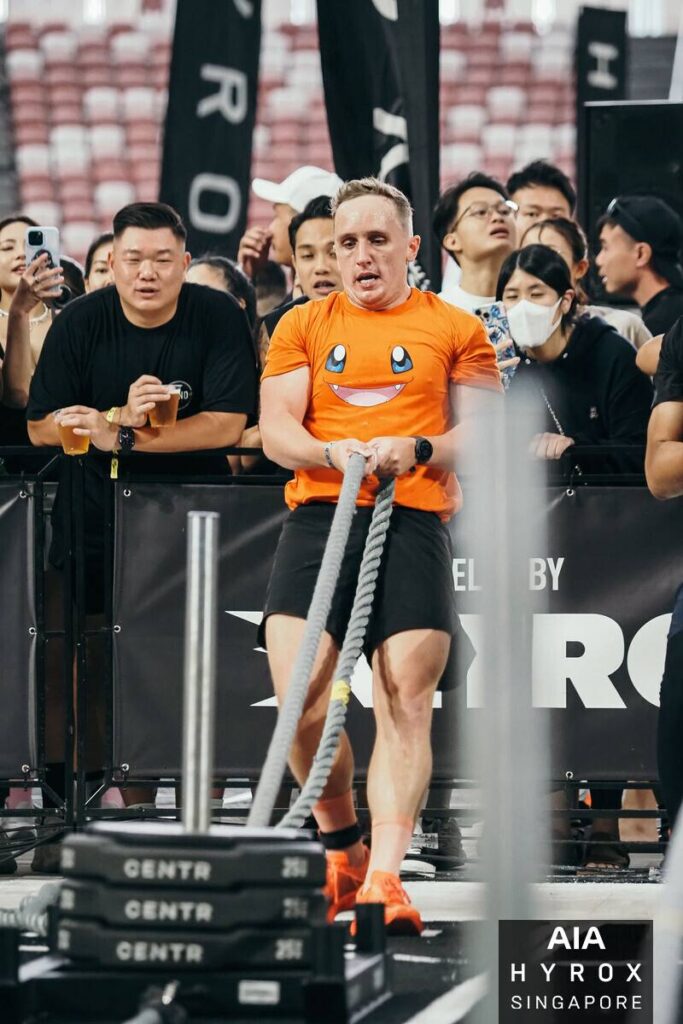
Credit: Sportograph
Continued Jim, “Then with tired legs, I had to return on Sunday morning for the doubles race. Waking upon sore and knowing I had to push hard again was pretty surreal – it was a deep grind both mentally and physically.”

Jim and Joakim, Men’s Doubles. Credit: Sarah Anne
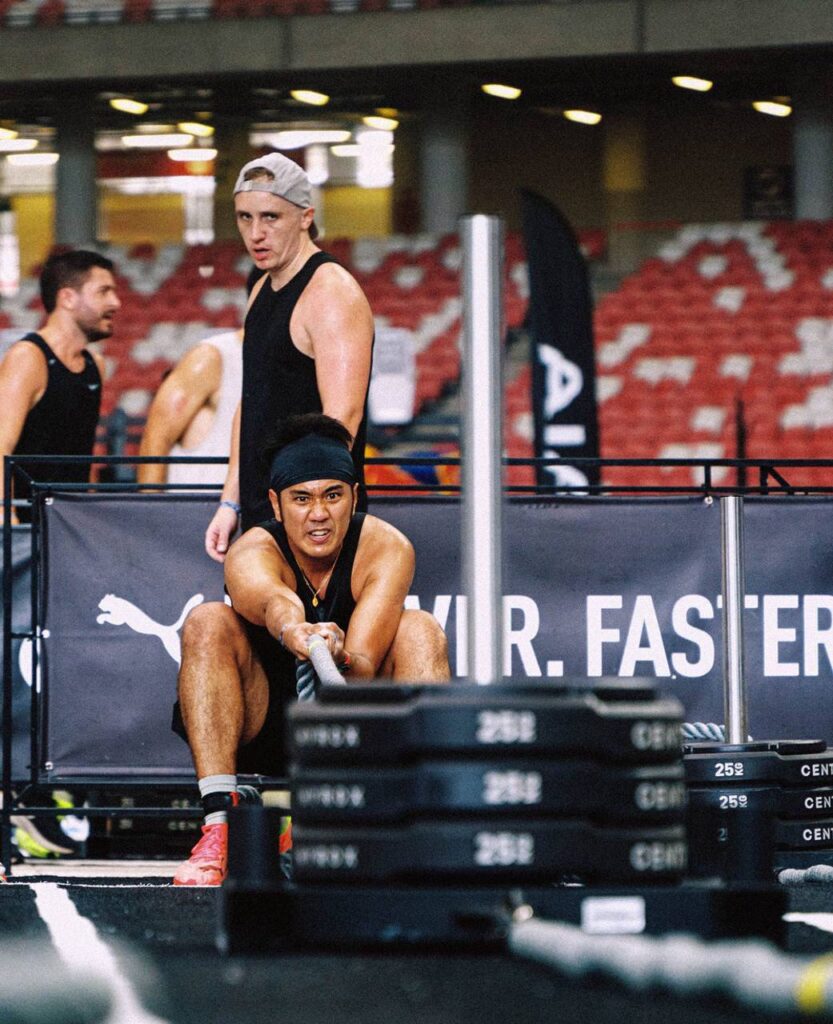
Jim and Joakim, Men’s Doubles. Credit: Sarah Anne.
For the doubles race, Jim teamed up with radio personality Joakim Gomez, the latter attempting his first Hyrox race.
With so many hard races in a short period of time, recovery was indeed crucial. Said Jim, “Recovery became a priority right after each race. I focused on hydration, electrolytes and eating enough to fuel between events. Foam rolling, light stretching and walking helped keep my legs from locking up too much. Between the solo and relay on Saturday, there wasn’t much time to do anything fancy – it was all about staying mobile and ready to go again.”
He added, “The real challenge was managing the soreness overnight before the doubles on Sunday. But I made sure I got as much sleep as possible as this is the number one recovery tool.”
For the men’s relay, Jim didn’t really spend much time or train together with his team-mates.
He said, “We focused on who we thought would be best fit for each station and went from there. Runners and triathletes typically have strong aerobic engines, but Hyrox adds functional movements to the mix. We incorporated some technique work on the sled pushes, lunges, ski-erg burpee broad jumps and other functional exercises. The goal was to test their ability to perform under fatigue, with their heart rate spiking high – something they don’t often face in their usual sports.”

They did it! Credit: Sportograph
It is a very different type of sport to what most runners and triathletes are used to, even though some running is involved in Hyrox.
Said Jim, “Hyrox is about repeatedly switching between running and heavy, functional movements with almost no recovery between them. In running and triathlon, it’s mostly about rhythm, pacing and aerobic efficiency. Hyrox is a mix of brute force and endurance with your heart rate maxed out almost the entire time. The race feels relentless – there’s no hiding.”
Thus to train for a Hyrox race, Jim recommends race-specific simulations where you combine running intervals with Hyrox-style stations.

Credit: Sportograph
He explained, “These sessions help build the exact kind of fitness you need for the race. I’m also a big believer in strength-endurance work – long sets with moderate weights that fatigue your muscles while keeping your heart rate high. Of course, aerobic conditioning remains important too; a strong aerobic base helps you recover faster between stations and avoid complete blow-ups. So running should always be the main priority if you are chasing a fast race time.”
Ironically, running is the most underlooked component of Hyrox according to Jim.
He said, “Many people are drawn to the event because of the functional fitness and heavy movements, so they spend most of their time in the gym working on strength and specific stations. Running tends to get treated as an afterthought – something they only take seriously after they have done a race or two and realise just how much of the event is running under fatigue. Hyrox is still very much an endurance event and if your running isn’t strong, you’ll struggle.”
Aside from running, Jim also feels that grip strength is underlooked in Hyrox training. He said, “This has always been important for stations like the farmers carry and sled pull, but now, with the new sled turf that creates more resistance, it’s even more critical. If your grip starts to fail, you’ll lose control during the sled pull and carries and it’ll really affect the later stages of the race. Prioritising grip strength alongside running and strength-endurance work is essential now more than ever.”

Credit: Sportograph
Why the Hyrox explosion in recent years, anyway? What is it about the sport that is making it so popular?
Jim gives his take. He said, “I think Hyrox fills a unique gap – it combines functional fitness with structured racing in a way that’s accessible but still brutally challenging. You don’t need to be an elite runner or powerlifter to take part, and there’s a clear pathway for progression. Plus, the events are well-organised with a great atmosphere. It’s a great mix of personal challenge, competition and community, which is exactly what a lot of people are looking for these days.”
Leave a Comment